by Lehua Parker | May 30, 2013 | Lauele Town Stories
 Being an only child, Kona was blamed for things he didn’t entirely do. The best he could figure, it was some kind of screwball adult logic that said if Mom didn’t do it and Dad didn’t either, it must have been Kona.
“Robert Konahele Inoye, get in here now!”
Kona groaned. Three names. He lowered his baseball cap and headed down the hall and into the kitchen.
“Yeah, Mom?”
“Kona, where are the Oreos?”
“Oreos?”
“Don’t play games, Kona. They’re not in the cupboard. I never had them; your father didn’t. Tell the truth. You snuck in the kitchen and ate all the cookies last night.”
“I just had a couple. With milk,” said Kona, pointing to the empty glass by the sink. “Just two. Not the whole package. Really.”
Mom narrowed her eyes. “Don’t lie to me, Kona. Who ate all the cookies if not you?”
He shrugged. “I dunno. Wasn’t me.”
“Those cookies were for the whole week! There are no more cookies. None for snack; none for dessert; nobody gets cookies now. Nobody likes a greedy pig, Kona. Whoever ate all the cookies is exactly that.”
Yeah, Kona thought, greedy, but not a pig.
Mom sighed. “Go get your backpack. Time for school. And don’t forget to make your bed.”
To download the entire story, please click here.
Excerpted from Sniff by Lehua Parker. Copyright © 2013 by Lehua Parker. Excerpted by permission of Lehua Parker, LLC and Lauele Press. All rights reserved. No part of this excerpt may be reproduced or reprinted without permission in writing from the publisher or author.
by Lehua Parker | May 28, 2013 | Adult Fiction, Book Reviews & Announcements, Pacific Literature

Lehua, Ka‘ao a ka Wahine, by Gene J. Parola combines historical narrative with forbidden romance to paint a portrait of life in Hawai‘i circa 1819, just as Queen Ka‘ahumanu lifts the kapu, essentially abolishing the ancient Hawaiian religion and turning the caste system on its head. It’s a period of Hawaiian history that is often glossed over as teachers tend to quickly move to the coming of the Christian missionaries soon after, and I appreciated a more thoughtful approach to the effect these changes had on both the ali‘i and maka‘ainana—chiefs and commoners alike.
When I studied Hawaiian history in school, Queen Ka‘ahumanu’s actions were portrayed as noble, wise, modern. It’s only lately that the hardships of the kapu system and other less noble motives such as a desire for worldly material possessions at too high a cost are being openly discussed as part of a more balanced conversation about that time.
As a descendant of both the white merchants and the ali‘i, I remember many family conversations, arguments really, about the reasons the Hawaiian nation was eventually conquered by business interests supported by the US government and whether or not this was a pono. Through Lehua’s journey, I was better able to understand the different points of view.
I just wish I could go back in time to some of those family discussions and ask more questions!
Lehua is the first in a trilogy that follows a young ali‘i woman through this turbulent time. I look forward to continuing the conversation.
Lehua, Ka‘ao a ka Wahine, by Gene J. Parola is self-published and available on Amazon and Barnes & Noble as a trade paperback and eBook.
Connect with Gene J. Parola
Twitter: https://twitter.com/gjparolawrites
Facebook: https://www.facebook.com/gene.parola
Blog: http://www.geneparola.com/
by Lehua Parker | May 27, 2013 | Learning ‘Ōlelo
 boroz, boroboroz
(BOW-row-z) (BOW-row-BOW-row-z) (n) Pidgin word for the the oldest, most worn-out clothes, one small step above rags. Worn when painting, doing yard work, etc.
Example
“How come you stay wearing your boroz? I thought the new clothes Mom and Lili bought you was sharp.” ~ Jay, One Boy, No Water
Note: ‘Ōlelo is a Hawaiian word meaning language, speech, word, etc. To see the current list of Hawaiian and Pidgin words, definitions, and usage please click on
by Lehua Parker | May 23, 2013 | Character Haiku

Now I’d rather be
sliding down a waterfall,
no cactus landing.
~Char Siu
by Lehua Parker | May 22, 2013 | Island Style
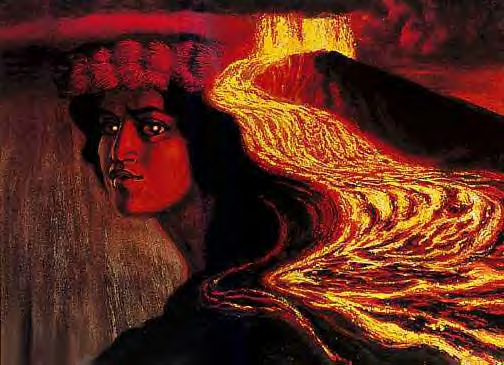
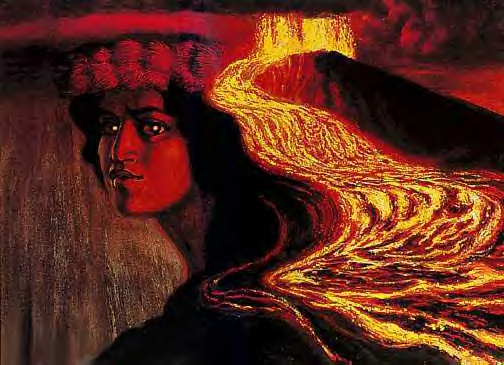
Living in the shadow of a volcano, there were many nights when I imagined lava pouring down Haleakala’s mountain sides and pooling in the hall outside my bedroom door. My sister and I even had a game where the floor was white-hot lava and you had to leap to safety chair by coffee table by couch.
Our mother was not amused.
Like Californians and earthquakes, mid-westerners and tornadoes, Big Island residents know that someday Pele’s fires will dance again, a ticking time bomb on a geological time scale of a minute or millennia.
Developers and bankers want to think a hundred years or more. My grandfather was in the insurance biz when developers in the 1970s and ’80s wanted to build on lava flows. He refused.
“There’s a reason it’s a lava flow, Lehua. Never build on a lava flow or a dry river bed.”
Probably some of the best advice he ever gave me.