by Lehua Parker | Mar 12, 2013 | Adult Fiction, Book Reviews & Announcements, Pacific Literature

Hawaiian Pidgin, as a language, is raw. It communicates on a visceral, no shibai level, cutting to the heart of the matter with a few quick words in an inflection that can leave you bloody on the floor. There’s a reason my kids don’t worry if I’m scolding in English; they know when I’m really mad the Pidgin comes out.
Significant Moments in da Life of Oriental Faddah and Son, One Hawai‘i Okinawan Journal by Lee A. Tonouchi is a powerful collection of epic poems written in Hawaiian Pidgin that tell the complicated story of multigenerational family relationships. It’s a semi-autobiographical journey from childhood into adulthood that made me laugh out loud, cry, and shake my head at Tonouchi’s very personal experiences that are on many levels so universal.
Tonouchi’s mastery of Pidgin rings true to the ear and heart with an eye for the significant detail that conveys pages of meaning in a few well-chosen phrases. I’ve never met Tonouchi, but I know his voice. I’m sure we hung out at the swings at Kahului Elementary, played shambattle at Summer Fun, and hid behind the oleander bushes at neighborhood backyard kanikapila jam sessions talking story, playing trumps, and swapping Diamond Head strawberry sodas.
Fo’real. His poetry is that good. If you’re a native Pidgin speaker, this book is a treasure.
Oriental Faddah and Son by Lee A. Tonouchi, published by Bess Press is available as a trade paperback directly from the publisher, Amazon, and Barnes & Noble and most stores where books are sold in Hawai‘i.
by Lehua Parker | Mar 11, 2013 | Learning ‘Ōlelo
 pāhoehoe
(PAH-hoe-hoe) (n) A type of lava that is smooth and often slick when wet.
Example
English: Billy! Don’t run! This lava is really smooth and—it’s okay! Don’t cry!
Pidgin: What I said? Das wet pāhoehoe, lōlō. You run like that in slippahs of course you going break your head.
Note: ‘Ōlelo is a Hawaiian word meaning language, speech, word, etc. To see the current list of Hawaiian and Pidgin words, definitions, and usage please click on
by Lehua Parker | Mar 7, 2013 | Character Haiku

Black ink glides and dances,
a girl with flowing hair peeks
out. My sister? Perhaps.
~Zader
For more character haiku click here.
by Lehua Parker | Mar 5, 2013 | Mainland Living
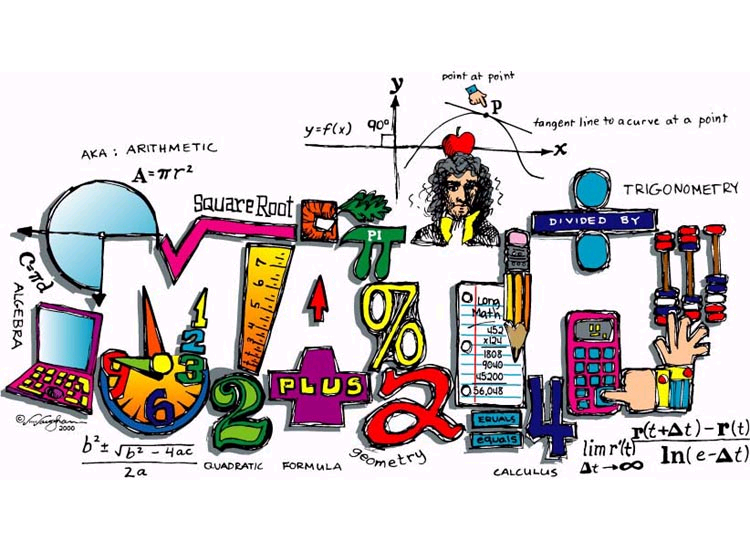
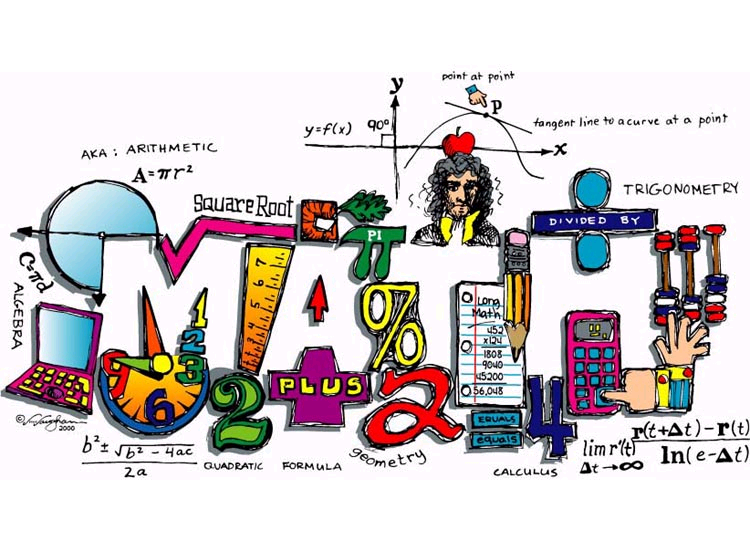 I hate math. My suspicions that the numbers game is rigged happened when Mr. Waters, my sixth grade teacher, taught us that a negative times a negative equaled a positive, clearly the most counter-intuitive idea ever.
I stuck with math through algebra and geometry until I hit a wall my senior year in calculus. After that, I avoided manipulating numbers. I barely scrapped by in required college stats classes where the biggest concept I learned was the truth of Mark Twain’s assertion that there are lies, damn lies, and statistics. I’d add politics to his list, but it’s not that kind of blog.
Before higher mathematics completely derailed any ideas of a career in physics or chemistry, I had hope that it would all make sense again, that some teacher would pop up like a cardboard character in a Monty Python sketch and say, “Just kidding! You were right all along! Here’s how it really works!” But the joke’s on me.
Back when I had faith that the light at the end of the tunnel wasn’t a train, algebra felt like a logic puzzle I could unlock, tumbling the Xs and Ys into solvable combinations as long as I played along with the wink-wink negative number story. I’d enjoyed geometry with its angles and planes and complimentary numbers that added to 360, the top-secret-insiders-only key to calculating right angles, building the pyramids, thin-walled cathedrals, and all that jazz.
I’ve retained enough math to balance a checkbook, to figure out how much square footage of carpet, sod, or paint to order, and to convert store discounts from percentages to dollars. Beyond that I’m pretty useless.
Which makes it tough when I’ve been the homework go to guy for so long and now I can’t help my son. I don’t tell him he’s taking the same math class as a high school freshman I took as a senior or that I hit the same conceptual wall he did and never found a way over.
I tell him to ask his Dad.
They’re sitting at the kitchen table as I type, heads bent and pencils scratching, working through cosins of imaginary numbers to calculate the number of angels that can dance on the head of a pin. I hear laughs and smacking high-fives when their answers match the back of the book. From now on Spanish and math are Dad’s domain; as Mom I can only watch from the sidelines and remind my son of deadlines and tests, a secretary’s role at best.
Better get used to it.
by Lehua Parker | Mar 5, 2013 | Adult Fiction, Book Reviews & Announcements
 Imagine you wake up in Las Vegas to discover you’re missing hours in a blackout that you fear is the result of a drugged assault. Now imagine that a few months later, just when you’re finding your groove, you get attacked again, but this time you’re rescued by a mysterious stranger who takes you to a remote location and tells you that he’s from the future.
Yeah, Maggie had a tough time with that one, too.
Past, present, and future blend a little in this series and a good portion of the beginning of the novel is taken up with explaining it all. Maggie was scooped from her original timeline and taken to the future where she was part of a rebellion fighting against the big collectives, hive-like mind control groups who have mastered time travel and want to enslave all humans throughout history. She lived and fought with the rebels for a year developing strong bonds as friends, family, and even the love of her life. Maggie got captured during a mission and had her mind erased, so she has no memories of her year with the rebels. Once rescued, the rebels decided that this was the perfect time to return her to her original timeline, resulting in the missing hours and bruises she couldn’t explain back in Las Vegas. Now for her own safety and to protect the ultimate destiny of mankind, she’s been scooped back into the rebel’s timeline. She’s surrounded by people who know her intimately who she doesn’t remember at all, fighting against the collectives in a highly specialized team.
There’s a lot to chew on in this book. There are elements in this series that echo some of the deeper mythologies in classic science fiction series like Dune. Readers who like to get into the nuances of how things work and what makes people tick will enjoy it—it’s an intellectually satisfying read. Once the backstory comes out, the pace picks up substantially and the pay-off’s good.
Persistence of Vision, Book 1 of Interchron, written by Liesel K. Hill and published by Tate Publishing is available in paperback and eBook. Click here for the link. http://www.tatepublishing.com/bookstore/book.php?w=978-1-62024-796-9
 Connect with Liesel
Blog: http://lkhill.blogspot.com/
Facebook: http://www.facebook.com/LieselKHill?ref=ts&fref=ts
Twitter: @lkhillbooks